
MetaFabric
The data and knowledge foundation for your applications and AI.
Business data is spread across many systems, and each one describes it differently. That makes it hard to trust, hard to build applications on, and hard for AI to use safely.
MetaFabric connects those systems, brings their data into one shared business model, and serves it to people, applications and AI agents. It is more than an integration layer: applications can use it as their system of record and read and write their data directly. Data keeps its link to the system it came from, and only the people and programs you allow can reach it.
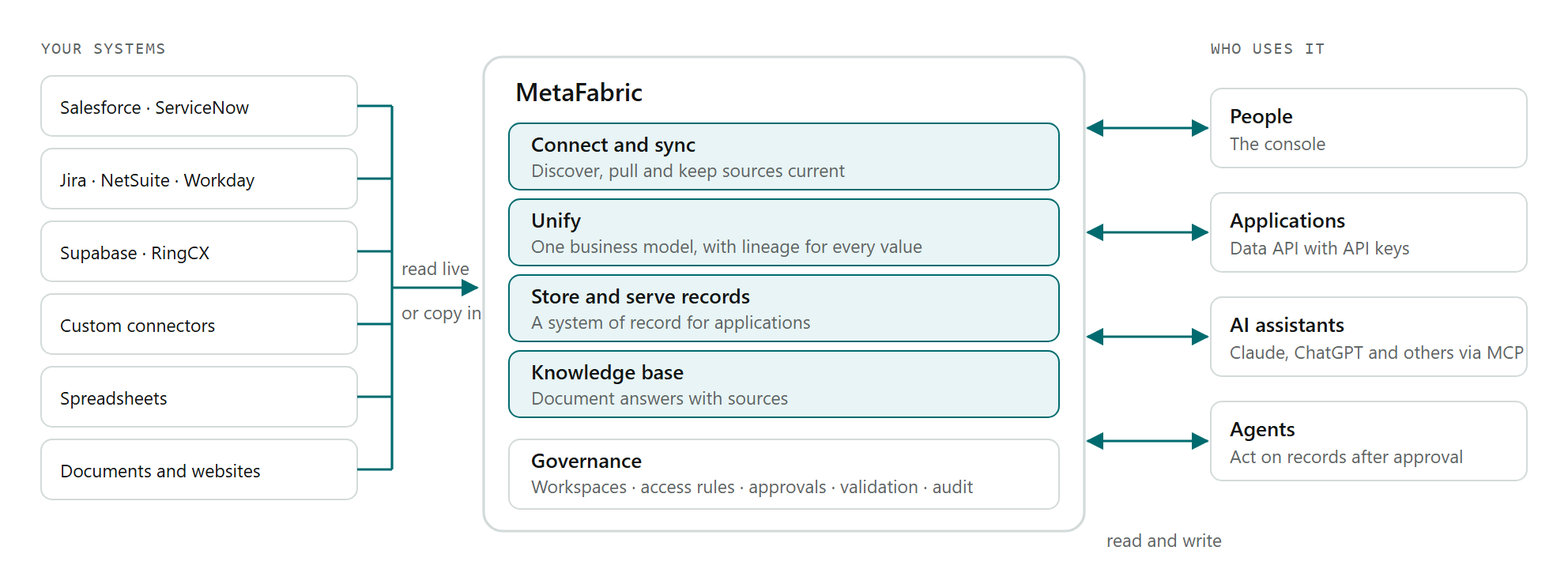
Figure 1. MetaFabric sits between the systems a business runs and everything that uses its data.
What it does#
Salesforce, ServiceNow, Jira, NetSuite, Workday, Supabase and custom sources.
Unifies the dataOne business model across systems. An account is an account, wherever it came from.
Powers applicationsA governed system of record that apps read and write through APIs.
Enables AI and agentsAnswers from your documents with sources, MCP access for AI assistants, and agents that act after approval.
Validates dataChecks loaded data against its source and flags what needs fixing.
Controls accessSeparate workspaces, roles, object permissions and record-level rules.
How it works#
There are three ways to use MetaFabric, and a workspace can combine them.
| Approach | What happens |
|---|---|
| Read live | Connect a system and map it to the shared model. Records stay in the source and are read when needed. |
| Bring in and unify | Copy a system's records in and combine them with other sources. A person approves before it publishes, and checks confirm it is complete. |
| Build on it | Applications create and manage their own records in MetaFabric through APIs. |
In every case the same access rules and audit apply.
Where to start#
| You are | Read |
|---|---|
| A leader evaluating MetaFabric | Capabilities at a glance, then Canonicalization |
| An architect | Architecture and services, Security, access and tenancy |
| A developer building an app | Application data foundation, Developer APIs, MCP |
| An admin setting it up | Connecting source systems, Security, access and tenancy |
Key terms#
| Term | Meaning |
|---|---|
| Workspace | An isolated space with its own data, users and settings. |
| Tenant | The same isolated space, as named in the APIs. Each workspace is one tenant. |
| Canonical ontology | The shared business vocabulary (ec:) all data is described in. |
| Crosswalk | The map from each system's objects and fields to the canonical ontology. |
| Mapping | The reviewed process of bringing one system's data into MetaFabric. |
| Knowledge fabric | The connected picture of a workspace's objects, their links and their sources. |
| System of record | The system trusted as the source of truth for a field. |