
Canonicalization and the knowledge fabric
Different systems describe the same business in different words. MetaFabric maps them to a shared business model, so data from any system carries a common meaning, and keeps track of where every value came from.
A shared business model#
The canonical ontology (ec:) defines business concepts such as Account, Contact, Case, Order and User, and how they relate. The crosswalk maps each source's objects and fields to those concepts, so Salesforce's Account and another system's Customer both mean ec:Account.
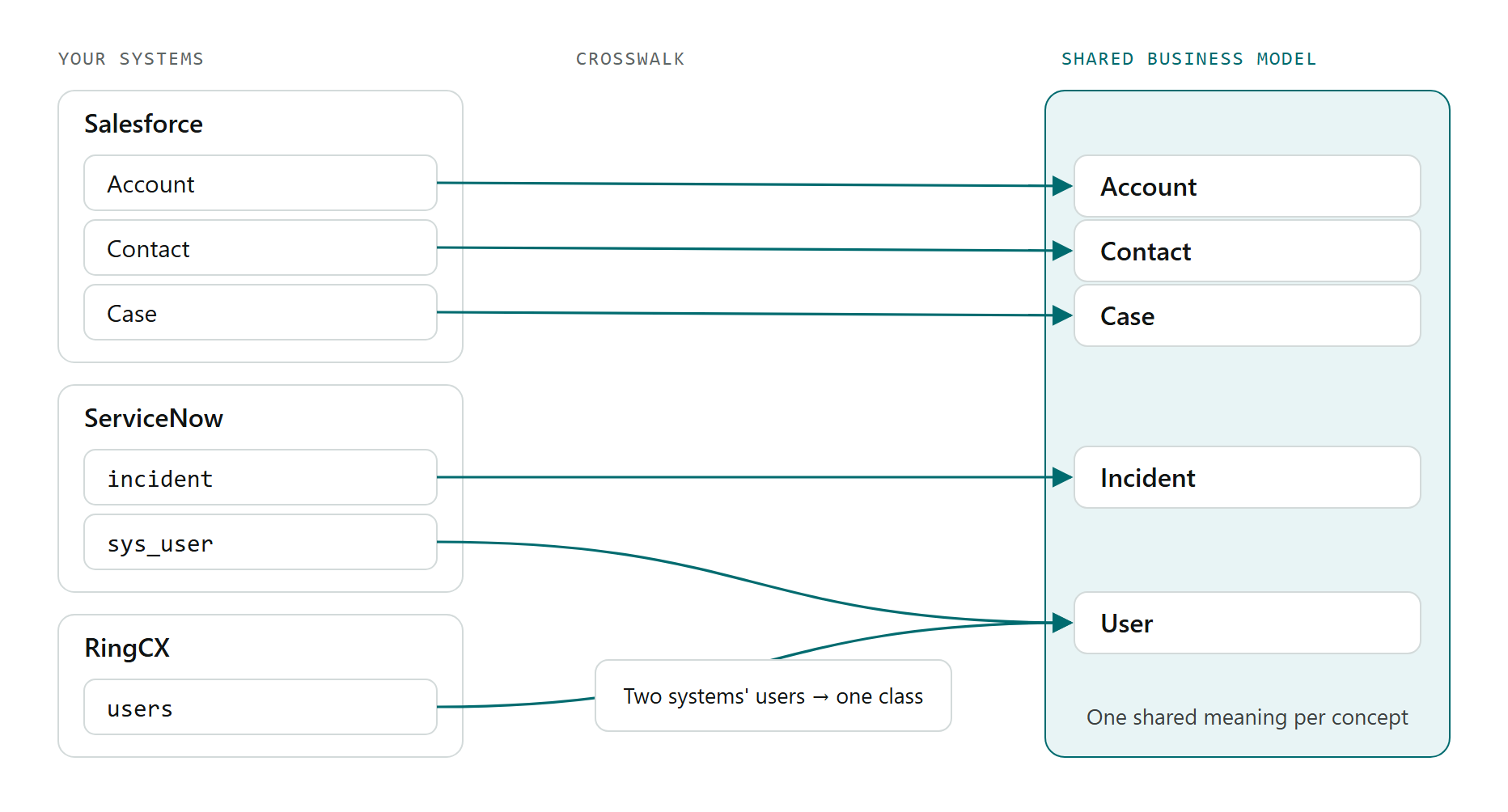
Figure 1. The crosswalk gives each system's objects a shared meaning. ServiceNow's sys_user and RingCX's users both map to User. This maps object types only. It does not merge any records.
An AI mapping copilot suggests how source fields match the model, and a person reviews each suggestion. Each workspace publishes its own version of the ontology, and can add industry packs or its own classes.
Decides what a source object means: a Salesforce Account is an ec:Account. It applies to every mode.
Decides whether two records describe the same real thing, such as one company in two systems. It applies only when data is brought in.
Unifying records#
When a source is brought in and unified (see Connecting source systems), each record goes through these steps. Unifying builds a combined view: the original source records are kept as they arrived, not changed or deleted.
| Step | Outcome |
|---|---|
| Clean | Values from each source are standardized. |
| Match | Records that describe the same thing are linked into one unified record. |
| Choose the trusted value | Each field takes its value from the most trusted source. |
| Keep the disagreement | Where sources differ, both values are kept for review. |
| Track the source | Every value records the system and field it came from. |
| Hold back doubtful records | Records that fail quality checks wait for review instead of entering the unified data. |
The result depends only on the data and the source rankings, not on the order records arrive in.
Source priority and conflict resolution#
Contributors and admins rank sources field by field, for example the billing system for addresses and the CRM for phone numbers. Where no ranking is set, the current value stays. Disagreements are not settled silently: each one waits in a review list, where a person can accept the result or choose the other value.
Duplicates#
Records that share a class are not duplicates. Duplicates are separate records for the same real thing, such as "Acme Ltd" and "Acme" in one system. MetaFabric suggests likely pairs, and a contributor or admin approves each merge. The duplicate's source links and history move to the surviving record, and its existing values win where the two differ. The original source records are not changed.
Lineage#
The Record lineage view under Mappings shows a record's journey from each source to the unified record, field by field. Field changes are kept for 90 days by default, and the server setting can keep them longer.
The knowledge fabric#
The knowledge fabric is the connected picture of a workspace: its systems, objects, relationships and record counts, each linked to its source. People explore it in the console, and apps and AI read it through the APIs and MCP. Each workspace's fabric is kept in its own graphs, separate from every other workspace.